Monday, January 17, 2011

Bowled Over: A Review


Seeing the Field: The Importance of Perspective in Bowled Over: Big-Time College Football from the Sixties to the BCS Era


By Michael Oriard. Published in 2009 by the Univ. of North Carolina Press, Chapel Hill, NC.


Recently, as I sat through a theatrically contentious faculty senate meeting in which university appropriations to intercollegiate athletics were hotly debated between faculty, administrators, and athletic administrators, I reflected over the following statement like a mantra:


“From the moment that university administrators […] realized that the new public passion for intercollegiate football provided opportunities for university building, (universities) have been torn between the competing demands of marketing and educating” (1-2).


This is the backdrop for not only the fierce negotiations between university administrators about the mission of higher education, but also the subtext for conversations never held between ardent college football fans who never step foot on a campus and the most strident defenders of higher education’s mission, who never step foot in a college stadium on a Saturday night. As a college football player turned athletic administrator and faculty member, I can appreciate the perspectives of all the negotiating parties. I can also appreciate the importance of perspective to the conveyance of a compelling story.


In the introduction to Bowled Over, author Michael Oriard reveals his analytical approach as ethnographer and historian to introduce his unique perspective on a rich area of consideration that is gaining increasing attention among the higher education studies – the proliferation of college athletics. This approach ultimately proves beneficial, in addition to being quite unique in sport culture criticism. As Mary Louise Pratt points out in “Arts of the Contact Zone,” it is important to depict “social spaces where cultures meet, clash, and grapple with each other,” especially when one is personally involved in those struggles (a reflective method known as autoethnography) (519). All too often, scholarship in sport management and higher education history is author-evacuated, de-contextualized, and personal experience relegated to introductory anecdotes rather than emerging as central to the analysis. The alternative is no better, with vignette vendettas and exculpatory exorcisms by authors who have been personally wronged in one way or another by the machinery and culture of the college sports industry.


In particular, what makes Oriard’s perspective so pivotal is that his career as amateur, collegiate and professional football player spanned a decade, which he labels “the long 60’s” (5), and contends was the most controversial in organized American football. The years between 1963-1974 not only saw watershed changes in American culture, but those cultural changes had an indelible impact on college sport, and the decade casts a longer and more significant shadow over college football as we know it to this day (6-7). Oriard’s first-hand experiences with and living through those changes as student-athlete-turned-professional athlete-turned university professor provide robust context for his often reasonable, and on occasion controversial, foundation-jarring claims.


Among the more controversial claims is that the institution of the one-year scholarship in 1973 transformed amateur athletics irreparably, and, that it was in response to the American cultural trend of 1960’s racial upheaval (7). And yet, this claim is made more compelling by Oriard’s experiences living through that period and experiencing those changes first hand.


Oriard also details a long list of radical action spanning the country from Washington State, to Wyoming, to Indiana, and Syracuse and many points in between. The everyday actions of players at those institutions challenged the cultural norms that dominated the football landscape previously and attempted to wrest college football from the Conservative and religionist movements Oriard claims had co-opted it in the early half of the twentieth century (46-47). Far from the “dumb jock” stereotype that dominates much thinking about the big-time college football player, football players became focal civil rights heroes in many cases and actually inspired participation in civil rights causes, from Ben Williams’ integration of Ole Miss football, the last bastion of segregation in the arch-segregationist SEC (81-84) to Eddie McAshan’s integration of the quarterback position at a major southern school (Georgia Tech in 190). Largely influenced by the African-American civil rights movement, and the social movement strategies it popularized in America[1], players made significant strides in transforming college athletics culture, but as Oriard points out, the rich history of athletes participating and spawning revolutionary action goes back to the strike breakers at Cal, Chicago, and Minnesota at the turn of the 20th century (24). Perspective is important here, because many of these stories have either gone untold, or have been retold to cleanse them of the bigotry and racism that permeated college football and its earliest heroes, the coaches. Oriard’s retelling of Bear Bryant’s integration of Alabama football is particularly crushing to his The Last Coach mythos as hard-nosed pragmatist committed to winning at all costs, even desegregation (60-62). Instead, we are provided with an analysis of Bryant’s decision to integrate his team as one borne both of humiliation and personal loss, not revelation or even the more crass realization that he could not win without black players[2].


Even at Notre Dame, far from the recently desegregated south, and the more racially progressive West, Oriard witnessed first-hand as student protests of the invasion of Cambodia and Vietnam on his campus were first rejected and eventually given a guarded “go-ahead” by Coach Ara Parseghian, who did not admit publicly that he was anti-war. And though Oriard is careful not to compare superficial cultural changes at Notre Dame (such as the way players were allowed to wear their hair and facial hair during this period changing drastically) to the student protests across the country for substantive social change, participating in and observing those movements at Notre Dame put the larger movement in perspective for him, and showed him once and for all that sport is not above or beyond the politics and culture of American society, but intertwined within it and in some cases, incredibly influential upon it. After all, as Oriard points out, there were black players integrating the SEC before 1970, but to white, southern football purists, Sam Cunningham and USC had as much of an impact on civil rights in the South as did Rosa Parks.


No matter how much credit organized sport is given for providing diverse groups of people the opportunity to consider racial and cultural difference in ways that it may never have been considered otherwise, it’s important to note that organized sport does not exist above, beyond, or in a vacuum where such matters do not have an impact. Even the concept of the “student-athlete” as we know it has been shaped by these factors, and Oriard shows us the impact of racial and cultural difference on the shaping of the student-athlete experience through the lenses of history, historiography, and personal experience.


Many take for granted that the idea of the student-athlete is one that is a remnant of ancient times, where young men would train their minds and bodies in conjunction with one another, and the gymnasia served as a space where bodies learned to be elegant and to elocute (see Debra Hawhee’s Bodily Arts for an excellent analysis on this topic). Oriard examines the phasing out of the “student-athlete” (and transition to “athlete-student”) through analysis of NCAA legislation, examining historical trends, and through personal reflection. Oriard points to a specific historical moment when the NCAA’s twice- failed and eventually successful attempt (under the leadership of avowed anti-radical Walter Byers) to pass legislation that eliminated the four-year scholarship provision and reduce it to one-year, renewable contracts between the university and the athlete (46). In doing so, Oriard claims, that the “student-athlete” was eliminated from big time college athletics, and the professionalization that we often cite synonymously with college athletics’ arms race began in sooth (130)[3]. Again, this footnote provides a perspective on college athletics oft unconsidered, that college athletics has not become the economic behemoth on the accord of local university administrators, or because of historical inevitability or capitalistic compulsion. Rather, because of unintended consequences, sanctioned racism and anti-radicalism, the biggest players in college football now closely resemble its earliest antecedents who hired mercenaries to compete for their institutions, bringing them glory and financial reward.


Oriard does more than suggest that this watershed moment occurred by citing transcripts and news reporting. Rather, he shows how racial upheaval and civil rights movements inspired both revolutionary movement among players and reactionarism among coaches and athletic officials, and he rewrites the institution of the one-year renewable scholarship as a sea change moment. It would become a means by which the NCAA could control player protest against institutional and cultural mores, remove talk of entitlement to workers’ rights (130-31), and eventually become the basis by which the NCAA would protect its non-profit status (thus increasing its and its members’ profit margins) for decades to come[4].


Oriard himself observed and participated in the cultural moments which precipitated the one-year scholarship legislation while a student-athlete at Notre Dame. Folks like Oriard, who himself claims to have gone to college for athletic and academic pursuits, are relics of the past, as the renewal is “contingent upon satisfying the coach … and that players must acquiesce in coaches’ increasing demands” (204) and that athletes who desire academic and athletic success are still possible, but succeed “against the system rather than within it” (206). The college football establishment, as well as conservative American political officials, claimed football as a bastion of anti-war and anti-radicalist sentiment, even though on college campuses across the country, these norms were being challenged and coaches who were becoming relics of a time long past became victims of their stubborn refusal to accept their players right to free speech and cultural expression. As he shows through careful narrative that explains how national trends impacted life in South Bend – his “well-barbered” teammates looking like “Eisenhower Republicans” upon his entrance in 1966 – and the painful and humiliating ushering-out of coaches who demanded their players stifle anti-war, anti-religion, and counter-cultural sentiment in all its forms by the time he was cut by the Kansas City Chiefs in 1974 (17-18). In the end, the passage of the one-year renewable scholarship bylaw reasserted the college football establishment’s Conservatism by threatening students’ rights and set the stage for student-athletes like Oriard to become a true minority in big-time college sport. It also, paved the way for big-time college football’s commercialism, and gave credence to critics who claim that their priorities must need place athletics over academics.


Rhetorically, Oriard’s arrival story as student-athlete who lived personally through the times he investigates and analyzes gives him considerable ethos as analyst and his colorful anecdotes as storyteller that make the read enjoyable and insightful. One minor drawback is that the lack of personal experience cited as backdrop for chapters that rely heavily on data to ground his claims leads to a rather dry and sometimes laborious reading. The lack of backgrounding for the drier statistical claims begs for either a co-author with commensurate experience to carry forward the storytelling/analysis juxtaposition, or, consultation with industry professionals – coaches, and athletic administrators in particular – who share similar sympathies for student-athletes and universities caught in the arms race of college athletics. Oriard’s methodological approach to cementing his central claims via personal narrative, supported by statistical, historical, and anecdotal evidence, suggests how a wider range of disciplinary and interdisciplinary inquiry might prove beneficial to the burgeoning study of American sport culture criticism.


References

Barra, Allan. (2005). The Last Coach: A Life of Paul “Bear” Bryant. New York: W. W. Norton

Press.

Broussard, William. (2009). “One foot in: Student-athlete advocacy in the margins of

American college athletics.” Issues in Intercollegiate Athletics.

2009-10 working paper series. University of Washington, Seattle.

Hawhee, Debra. (2005). Bodily Arts: Rhetoric and Athletics in Ancient Greece. Austin:

University of Texas Press.

Pratt, Mary Louise. (1991). Arts of the contact zone. Profession, 91, 33-40.


[1] I’ve written about this elsewhere, namely, in “One Foot In: Student-Athlete Advocacy in the Margins of American College Athletics,” as part of the University of Washington Intercollegiate Athletic Leadership working paper series.


[2] Oriardi notes that Bryant likely lost a fourth national championship in 1966 because sportswriters did not appreciate his unwillingness to integrate. His undefeated Crimson Tide finished second to 10-0-1 Notre Dame.


[3] Even though the practice of recruiting individuals to play for a collegiate team by contract wet back to the late 19th century, Oriardi claims that the one-year renewable contract was the most significant move in the commercialization of college sport ever.


[4] This is the predominant subject matter of Chapter 1, “From the Sidelines of a Football Revolution,” pp. 15-56.

Sunday, December 12, 2010

Michael Vick is a Player (MVP)

From the November 27th issue of "The Real Views"

Most professional athletes who fall from grace for personal or legal reasons never return to their former glory while atoning for their transgressions. Sure, Jason Giambi had several good years after publicly admitting using steroids in 2004, but he didn’t embark on a nationwide tour preaching against the dangers of steroid use. Gilbert Arenas, after being sentenced to two years probation for illegally bringing in and storing weapons in his locker at the Verizon Center (and serving a suspension for half the 2009-10 NBA season), wrote a thoughtful apology in the Washington Post and promised to be a better role model, but his ppg and assists are down significantly and his Wizards are 5-10. And Tiger Woods has been featured more on Taiwanese television than in America since his all-too-public fall from grace, earning less money in 2010 than in any year as a professional golfer.

It seems that though many professional athletes run into trouble, personal and legal, that it is all too rare that they come back and successfully repair their public images while performing exceptionally on the field of play. After returning to the NFL with a 23 month sentence for his involvement in running a dogfighting ring behind him, Michael Vick has done more this season to rehabilitate his image on and off the field than any professional athlete in recent memory. Vick, somehow has bucked that trend mightily, and in such a manner that Andy Reid has stuck with his hot hand in spite of the fact that Kevin Kolb, named starter at QB to begin the season, has played well, led his team to a couple of wins, and has a respectable 85.3 passer rating in 7 games this year.

Vick’s on-going apology has been remarkably earnest, if imperfect, and robust even if not well-received (Philly Mayor Michael Nutter is an exception, endorsing Vick on Meet the Press on November 28). He has reached out to PETA (http://bit.ly/gdP6Q) and the ASPCA (http://bit.ly/x1sJv) and the Humane Society (http://es.pn/11Cwx2) in attempts to discourage youth from engaging in the behavior that led him to lose millions of dollars in endorsements and the respect of many fans and gain as ardent enemies animal lovers across the world. And though it was an ill-fated television show, he even contracted with Black Entertainment Television to air “The Michael Vick Project” in order to tell his personal story to television viewers and have cameras follow him around as he introduced the world to the context of his upbringing.

Though he has many detractors (read:haters) who remain, keep Vick’s efforts at earnestly apologizing and carrying through on his promises to make things right in perspective. Roger Clemens never apologized for cheating, and neither did Brett Favre (the former allegedly with steroids, the latter allegedly via cell phone), but one could imagine that if they did, they would be admonished and then soon forgiven. Tony Hayward (of BP infamy) apologized his bum off, but I don’t think for a second that anyone bought his mawkish sincerity or that of any of the actors he trotted out over the coming months claiming to want to “make (things) right.” And have you heard a single apology from the CEOs of Countrywide, Lehman Brothers, AIG, and the many other companies whose malfeasance is the cause for the decline in American economic prosperity we are facing today? What is their penance? Being fired and retiring with multi-million dollar golden parachutes and no jail time? Vick made horrible mistakes in his life, did jail time and paid restitution and loss millions in earnings as a result. He has asked fans, those whom he offended, and even Jesus for forgiveness (http://bit.ly/fMOPJu). In the America that we often tout as a land of second chances, where a man has the right to earn a living and pursue his dreams legally, the hate towards Vick is disproportionate, and frankly, poorly targeted. If only Angelo Mozillo were an NFL quarterback …

However, if Vick’s life off of the field has been scandalized, his performance on the field, as Dave Chappelle would say, has been “scandal-proof.” With a 108.5 passer rating, he’s led the Philadelphia Eagles to first place in the NFC East, a 7-3 record (5-1 as a starter), and has not thrown a single interception all season. His November 15th MNF performance may have been the most amazing statistical performance ever by an NFL quarterback, accounting for six touchdowns, 413 total yards, and becoming the first NFL QB to ever accumulate 300+ passing yards, 50+ rushing yards, 4+ passing TDs, and 2+ rushing TDs in a single game. All of this has come in the wake of an 11-5 season in 2009, after which the Eagles traded their star quarterback Donovan McNabb and left huge shoes to fill (the Eagles had gone to five NFC Championship games and a Super Bowl under McNabb). Vick is on pace to throw for 2,500 yards and 17-20 passing touchdowns (while running for 8 more). Sure, it’s not the 4,500 yards and 33 touchdowns that 2009 NFL MVP Peyton Manning accounted for, but he is also on a pace rushing the ball that would make him the leading rusher on Indy’s 2010 team. And he’s led and won in every way that a quarterback can, rushing for over 100 yards vs. Green Bay, throwing for three touchdowns and 291 yards vs. Jacksonville, and in his worst statistical game of the year, threw for 258 yards and ran for a touchdown in a win against NFC East rival New York Giants.

A Michael Vick who remains injury-free, throws for 20 or more touchdowns and 2,500+ yards and leads Philly to an NFC East championship and a healthy playoff run (NFC Championship or better) is my lock for 2010 NFC MVP (otherwise, it’s obviously Drew Brees, and maybe a resurgent Cowboys team makes Jason Garrett third!). No one player has been any more important to his team’s success after 10 weeks of the NFL season, and if he continues on this pace, his story will continue to serve as hyper-controversial to many (if not most), but redemptive all the same to one Michael Vick.

Besides, Manning is running out of mantle space by now, and what the hell is Tom Brady gonna do with another trophy, besides marry it?

nb: as of 12/10, the 1st place Eagles are 8-4, and Vick has thrown for 2,243 yards, 15 TDs, and accounted for 21 TDs.

Thursday, September 30, 2010

The NCAA: Never Cares About Academics

"Touchdown/Point After" from The Real Views

By William Broussard

Cast aside your aspersions, if you have them about college athletics, for just a second. Clear your mind of the sad case of Reggie Bush, found to have accepted various and sundry contributions while a student-athlete at USC, leading to him forfeiting his 2005 Heisman Trophy. Forget, for just a tick, about the University of Florida’s Chris Rainey, the university’s 27th player arrested in six years under head coach Urban “Should I Stay or Should I Go?” Meyer, who allegedly stalked a woman and sent her a text message reading “Time to die, B#$%h.” Forget the University of Tennessee’s Derek Dooley granting premium press access to particularly kind sportswriters while denying access to, you know, journalists, or his predecessor in journalistic integrity, Mike “I’m 40!” Gundy of Oklahoma State, who just verbally assaults journalists when he disagrees with them. And please, forget everything you know about Lane “Monte’s my Dad, ICanHazBCSJob?” Kiffin at Tennessee/USC/Next highest bidder in 2011.

Done forgetting those things? Me either. I’ll probably need a Neuralizer ™.

But put in context, college athletics is not about corruption, greed, law-breaking, abuse and scandal. In fact, the vast majority of student-athletes competing at the NCAA’s highest level, Division I, represent the 350 institutions where they study and compete, as well as those host institutions’ communities, with grace, aplomb, and high honor. The vast majority of college student-athletes are not committing crimes. They’re not accepting bribes. Heck, I was a two-time football all-American and I was never even offered one! And they are, for the most part, graduating at rates that exceed that of their non-student-athlete counterparts. They’re studying their tails off, matriculating successfully, bringing significant honor to their families and communities, and the vast majority of them are going into professions that have nothing to do with sport after graduation.

So why do stories about college athletics focus much more on what’s wrong than what’s right?

Consider the case of Jeremiah Masoli, formerly of the University of Oregon, and currently of the Southeastern Conference’s University of Mississippi (Ole Miss). Masoli, after leading the Ducks to a Rose Bowl berth in 2009, was finally, and embarrassingly, dismissed from the team for being charged with a second misdemeanor in as many years. Keep in mind that LeGarrette Blount, who became infamous in 2009 for socking a Boise State player in the jaw after an embarrassing loss on ESPN only got suspended for 6 games at Oregon, so to be suspended from the team, Masoli’s character issues and lack of potential for reform must have been considerable. So when we learned that Masoli planned to transfer to Ole Miss to play football, for so many reasons, many assumed that the NCAA would not approve his application to be immediately allowed to play. For one, transfers from FBS programs to FBS programs are required by NCAA rules to sit out one year. Secondly, transfers are required to be in good standing with their previous institution to be eligible—being suspended isn’t exactly ‘good standing.’

And yet, there he was, on September 4th, just weeks after he announced he would transfer from Oregon, leading the Rebels in overtime against the Jacksonville State Gamecocks, going 7-10 for 109 yards and an interception. Sure, it was an embarrassing home loss, 49-48, and an inauspicious (and in the eyes of many, all too apt) debut for Masoli, but I can’t get over the fact that the NCAA sanctioned his appearance at all. Ole Miss didn’t deserve the loss, and it didn’t exorcise any of my disdain.

Masoli didn’t break any rules to get eligible (though he broke several at Oregon in the first place to become ineligible to play there) and he exploited a loophole to gain a fifth year of eligibility at Ole Miss by enrolling in a graduate program there that was not available at Oregon (Parks and Recreation). Let’s assume for a second that Masoli fully intends to work in the Parks Service upon graduation and give both Oregon and Mississippi the benefit of the doubt for helping Masoli resolve the best way forward for himself after some mistakes in his past (after all, I adore magical realism, which requires one to suspend reality for the sake of the greater power of the narrative). The fact is that in order for moves like this to happen and the NCAA not appear completely crass and uniquely interested in big profits and preserving the profitability of only its biggest brands, it has to land hard on others. And anyone who follows NCAA Football closely knows that the stiffest sanctions are typically leveled on the meekest among the programs.

When APR (Academic Progress Rate) penalties were first issued, punishing programs that did not graduate 50% or more of their players by a series of calculations that include retention and eligibility, the bulk of the scholarship penalties went to non-BCS conference FBS and FCS schools. And while individuals like Masoli get second chances and earn the disgust of fans across the nation, the NCAA can rely on stats which show the significant number of scholarships that the NCAA mandates be cut from academically underperforming programs – this of course rarely happens to Oregon and Mississippi, but much more likely to Portland State and Mississippi Valley.

Masoli broke no rules in getting eligible to play at Ole Miss. Oregon broke no rules in releasing him. But the NCAA continues to make commonsenseless decisions that allow (student)athletes affiliated with their biggest brands to exploit loopholes while others at their lesser brands follow a much stricter set of rules, enforced in a manner more draconian, with much stiffer consequences for non-compliance. Masoli benefits, but we must realize that this was about the BCS, the Pac-10 and the SEC. The NCAA’s commitment to the potential redemption of one young man looking for a second chance appears purely coincidental.

William Broussard is an assistant professor of language and communication and associate director of athletics at Northwestern State University of Louisiana. He blogs at Manifold Superlativity. Follow him on twitter @LouisianaNormal.

Wednesday, June 30, 2010

A great week for diversity in intercollegiate athletics

Last week, I spent a week working with and learning from individuals deeply committed to promoting diversity in intercollegiate athletics – The National Association for Collegiate Directors of Athletics (NACDA) and the Center for Intercollegiate Athletics at the University of Washington. Both organizations’ commitment exceed the superficial, perfunctory, and obligatory commitments made by organizations and reflect a deep commitment to identifying future leaders in college athletics from all walks of life.

Monday morning, I visited with Dr. Jen Hoffman, a researcher with the Center for Intercollegiate Leadership at the University of Washington in Seattle. The center, whose mission is to provide instruction to future leaders across the spectrum of collegiate athletics, including coaches, policymakers, and administrators, and support research on all areas of college athletics, is thriving, increasing its graduate cohort manifold in its brief existence. The executive masters program emphasizes leadership training among its diverse student leaders, who from the cohort I visited with represent many disciplines, geographical regions, ethnicities, and age groups.

The rest of the week, I spent visiting with hundreds of college athletics administrators from across the country at the NACDA national conference in Anaheim, CA. NACDA highlights the efforts and achievements of athletic administrators across the country. It was clear that regardless of region, race, gender, age or any other cultural affinity that if you run a good department, or show promise in your field, your efforts will not go unnoticed. This was apparent not only at the recognition of future leaders in college athletics through the John McClendon Scholarships, which provide scholarship support to future athletic administrators, but also at the Minority Opportunity Athletic Association and National Association of Athletic Development Directors (NAADD) Diversity Initiative programs. As a past recipient of the NAADD Diversity Initiative award, which funded my participation in the conference’s fundamentals of athletic development workshop, I can tell you that the organization puts its money where its mouth is when it comes to promoting diverse participation.

I also had the privilege of watching my boss, Northwestern State Athletic Director Greg Burke, receive the Under Armour Athletic Director of the Year award as one of 20 recipients from across the nation at the FBS, FCS, Divisions I, II, and III levels and NAIA. It was very interesting to look upon the dais, and out at the attendees of the honoree luncheon, and take note of how truly representative the group was of many different ethnic and gender groups.

It was an encouraging week, to say the very least, and one which provided instruction for the near term and hope for the future of college athletics.

Sunday, June 20, 2010

My Father, the Sports Legend

From The Real Views Online

It’s a cliché to suggest that someone’s sports hero is his father. The person who taught you how to shoot baskets, swing a baseball bat, field a ground ball, or catch a pass ends up getting a significant jump start on all other contenders. I spent my early years as a sports fan cheering on Tony Dorsett, Michael Jordan, and Frank “Big Hurt” Thomas, my dad got a big jump start on all of them, collecting points for getting in there first. Sure, my father couldn’t hit a baseball 450 feet, windmill dunk a basketball, or juke a defender out of his cleats, but his endorsement of my failed attempts to do so, and patience as I repeatedly failed (until my body caught up with my desire and I failed less frequently) trumped all that.

However, my father was a considerable athlete in his own right. He was a legend, in fact. I should have suspected as much from watching my father shoot hoops in the backyard. I certainly remember him missing shots as we took thousands of them in the backyard, but can’t say that I remember him missing more than a dozen. Ever.

People used to ask me if I knew how good a basketball player my father was. In the barbershop. After church. People who had no reason to say so would tell us he was the best to have ever come from Crowley, Louisiana. That he could outmaneuver smaller guards who should be quicker than he was and run circles around forwards his size (he was 6’3, 220 lbs). He’d take shots that drove his coaches crazy (until they rimmed in) and played in a way that made every coach, except for the one at segregated Ross High School, even crazier. He earned a scholarship to Grambling State and was Willis Reed’s teammate for a year or two in the early 60's, and later became a pretty good high school coach (winning a state championship as an assistant under John Brady, who’d later coach LSU to a Final Four).

Of course, that demanding and uncompromising coach never showed up at 807 N. Ave C.

One of my memories of my father as a basketball coach involved him constructing a rudimentary basketball goal in the backyard. A plywood backboard with a makeshift rim attached, nailed to the roof of the house (thank God there was no homeowner’s association). After dispensing with the fundamentals, holding the ball, dribbling, etc., he then showed us how to shoot. He reared the ball back slightly behind his head, jumped slightly while rolling the ball off the tips of his fingers, and the ball went straight through, not even touching the rim. My brother followed suit, awkwardly, but at least looked the part in doing so. My first shot, however, was a disaster of the most epic sort for someone as good a ball player as my father.

I recall hitting the backboard, but I may be remembering myself better than I was. I did not hit the rim. I did hit the roof, but only the very bottom of it, and the ball had such tremendous and unnecessary backspin that when it hit the ground, it nearly bounced back and shattered my parents’ bedroom window.

My father looked down at me, said something encouraging, and went inside, I suspect, either to cry silently, or more likely, laugh until he wet himself.

Over the years I dribbled a path in my backyard, along with my brother and his friends playing pickup games that literally destroyed the grass underneath. And my father never bothered, never over-instructed me, and seemed content with the fact that we’d rather beat half court traps in the backyard than trap out in the streets.

When my brother and I took to baseball, he not only enrolled us in Little League, and bought bats and gloves so we could practice, but alternately drove my brother and I to Arlington and Houston every summer so we could watch the big leaguers do it. My brother and I became football players (not so much a choice as a dictation by our body types), and there was neither a hem or a haw that we take up basketball. Of course, neither hem or haw would have corrected my shot, but that doesn’t stop many many parents from insisting their children participate in sports. Only once do I remember my father insisting that I participate in a basketball-related activity – and that was when he, my brother, and I saw Julius “Dr. J” Erving play an exhibition game in his final season against the Chicago Bulls at the Cajun Dome in Lafayette. Good call.

Late in my father’s life, in what he said was one of his proudest moments, I was named an All-American football player. In his frailty, he pumped his fist and said “finally.” His dreams left unfulfilled in college as his career was ended too soon from a knee injury, he got to see his son reach a pinnacle of sport; a pedestal he’d deserved but was too humble to proclaim and too unlucky to ever reach.

Or maybe, finally, the basketball star remembered the son’s humble athletic beginnings, and now relished coming back out “in the yard” and watching him play.

Or maybe, he was vindicated in his approach to being a star athlete who becomes a parent. He wanted as much as anything for me to succeed in athletics, but refused to be a helicopter parent, harass coaches who didn’t start me or whom he felt played me in the wrong position, or esteem me solely on the quality of my athletic performance. Rather, he encouraged me to see sport as something to do, not the only thing to do, not the only thing I could ever do. And we still came out on top.

To every father, like mine, who lets his son become who he is to become, Happy Father’s Day.

But I still think my dad could’ve beaten your dad in basketball.

Thursday, June 3, 2010

Jim Joyce and the Jinx

"Si se puede!" -- UFW rallying cry (that Obama jacked later)
"No Pudimos!" -- Jim Joyce, June 2, 2010

On my way home from work yesterday evening, I noticed an interesting message on my TweetDeck. A Twitter pal of mine posted the following message:

@NameRedactedToProtectTheQuasi-Innocent: Before this season, there were 18 perfect games in 135 years. 1 every 7 1/2 seasons. Galarraga is 6 outs away from the 3rd PG this season.

This is what us die-hard sports fans know as a "jinx." And before you bombard me with requests (Tiger Fans) to know who, in fact, issued this hex on Armando Galarraga (before the blown call and after) I will never give up my sources. I have too much integrity to do that. Plus I dont want to lose precious Twitter followers. But I digress ...

I've seen too many jinxes to relegate the phenomenon to sheer superstition and coincidence. Athletes at the very apex of athletic performance are under the constant threat of jinxes undoing their historical achievements. They can engage in jinx-blocking, such as the antics of caricaturish chicken-sacrificing Pedro Cerrano all they want. The fact of the matter is, with history, gravity, circumstance, and all else against you, the jinx is the little extra boost that keeps the asterisk from appearing next to your name when all is said and done.

How many times has the announcer chimed in with an esoteric and marginally important statistic only to watch the streak in question end before she/he can finish the sentence?

How many times have you exhorted in wonder as you witness a historic athletic performance happening, as if you are the first genius to notice it (when actually, all of your other friends are following jinx etiquette and keeping their mouths hushed!) and then just like that, it's over. And then all of your friends look at you the way Big Perm looked at Smokey countin' out $200 in Friday.

And if you're an athlete, how many times has your teammate or coach looked over to you, whispered how close to greatness you are, and on the ensuing possession dribbled the ball off his shoe/dropped a lazy pop fly/or fumbled to fulfill Cleveland's history as Heartbreak City?

I watched the final inning once I got home. I didn't know what would happen to prevent Galarraga's perfect game, but I knew beyond the shadow of all doubt something would.

It's Detroit, anything could have happened.

The sound of the doors shutting down at Mercury could have distracted Galarraga, forcing him to hang a curve.

Galarraga could've been Artested by a beer cup.

Shots coulda rang out because Benzino gave The Detroit Tigers 2/5 mics this year, leading to a fan-athlete n#@$a moment.

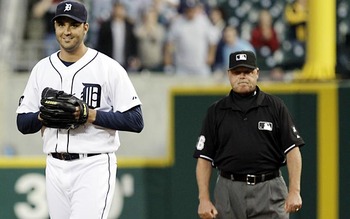
In the end, Jim Joyce made what is being called one of the worst missed calls in umping history. No matter. He couldn't have helped but. Because tens of thousands of people across the country probably started jinxing Galarraga after 5 1/3.

And ... it's Detroit. The whole damn city seems jinxed right now, why should Galarraga have have it any different?

nota blacke: have not yet seen the transcript, but I heard that immediately after the game, Arizona governor Jan Brewer issued a statement thanking Jim Joyce for his efforts. With Joyce's missed call, Brewer now drops to second place in the category of "White Folks Associated with Denying Opportunities for Hispanics in America."

My latest post on Athletics Development Frontier

Athletics Development Frontier

Sunday, May 30, 2010

A little love from the St. Pete Times

I was given a citation in "Black Coaches and Administrators' efforts boost ranks of minority college football coaches" by Antonya English of the St. Petersburg Times last week. I'd previously written an open letter to the Black Coaches Association where I was generally critical of their evaluation process of institutions hiring head football coaches, and specifically critical of their evaluation of our efforts at Northwestern State.

I'm glad Ms. English took notice. I only wish the BCA had done so, as well.

The full article is here.

Bryant D's up Phil Jackson ... Vanessa Bryant, that is


also featured @ ThisWeekinBlackness.com

The Los Angeles Lakers struggled at the close of the regular season and had to battle off a scrappy Oklahoma City squad (Kevin Durant, fresh off a regular season scoring championship, totally dropped the mic at Kobe’s feet after rocking it in game 3) to get to the Western Conference semis against the Utah Jazz. And then, as if fresh from the cool waters of Lake Minnetonka, the Lakers arrived at the 2010 NBA Playoffs.

Eight games later, including a sweep of the aforementioned Jazz, an average margin of victory of nearly 11 points, the Lakers seem invincible. Kobe has scored 30+ in eight straight games. Pau Gasol dropped 29 in Game 2. A game after Amare Stoudamire called Odom’s Game 1 performance “lucky” (he had 19 pts./19 rebs) Ol’ Smashin-a-Kardashian poured in 17 and 11, respectively. Other than Shannon Brown’s missed dunk (which wasnt challenged by Richardson as much as it was observed) ...
Richardson: no this m#@$%f@#$% aint. oh s@#$ this m#@$%f@#$% is. Hope he miss ... PHEW!

... really, who has challenged the Lakers thus far in this series?

Other than Vanessa Bryant, that is.

Ms. Bryant showed up wearing a T-shirt which read "Do I look illegal?" for Game 1 (for once, the $4 mil rock on her finger was overshadowed by another accoutrement). Ms. Bryant, who is Chicana, as are her two daughters with Bryant, issued a clear challenge to the anti-immigration legislation adopted by Gov. Jan Brewer of Arizona. Brewer, who collaborated with Rep. Russell Pearce (a white supremacy sympathizer) was looking for a poll bounce, considering her ~20% approval approval rating just months ago. Though she has received that bounce, she, and her state by extension, have been vilified in the national media, hearkening back to the state's tardiness at adopting a MLK holiday in the late 80's (I've written about this here).

Her choice of attire ironically challenges the beliefs of Lakers head coach Phil Jackson more than it does anyone on the Suns' team. The Phoenix Suns actually side with Ms. Bryant on the issue, famously and controversially donning "Los Suns" jerseys for Game 2 of their series vs. the San Antonio Spurs in support of Latinos in the Phoenix community. Jackson, who has a) come out in support of SB 1070 and, b) made other controversial and culturally insensitive comments about people of color in the recent past (and got that ass ethered by Scoop Jackson for doing so) has incensed Laker fans of every ethnic and cultural background by doing so. And his comments regarding the Suns' and Ms. Bryant's expressions of dissent has done more to engender negative feelings associated with his ball club, including protests of their home athletic events.

In the end, Ms. Bryant has exposed Phil Jackson's true colors. And none of them are darker than paper bags.

So during those long stretches of the Lakers v. Suns games, when the Lakers go on 15-0 runs, Kobe is hitting turnaround fadeaways for 2 sets of 10 while Steve Nash and Amare Stoudamire stand idly by, waiting to get back to AZ so someone can ask Pau Gasol for his documentos, take a minute to think about Phil Jackson's effed up politics. Imagine how someone who has spent this much time coaching and working with people from all over the world could so cavalierly criticize their culture, dismiss their humanity, belittle their existence. Reconsider cheering for a man who sees no value in your affinities or expressions of heritage and tradition.

I'm not saying don't rock the purple and gold. I'm not saying boycott the Lakers. I am saying that if Phil Jackson doesn't value the lives of black and brown and Latino people, then he'd be coaching Luke Walton to dish the ball to Adam Morrison, and you wouldn't even have a damn team to cheer for right now. Thanks for pointing that out, Ms. Bryant.

nota blacke: Word has it that in retaliation of the Los Angeles City Council's decision to boycott Arizona's passage of SB 1070, the anti-immigration/show me your papers/si se puede (vamanos) bill, the Arizona Corporation Commission is threatening to turn out the lights in Los Angeles, as it provides nearly 1/3 of the City of Los Angeles' electricity. Damn. Arizona wanna make erryone look illegal (if erryone is dark, do erryone go to jail?).


On the plus side for the Suns, maybe the Vegas odds dip below 10 points if the lights are out in Staples.

Tuesday, May 11, 2010

Shocking Behavior–The Philly fanatics and the decline of fan civility in American sport

The aptly named Philly Fanatic, beloved mascot of the Philadelphia Phillies

From the forthcoming 5/21 edition of The Real Views Magazine

A fan, by nature, possesses an intense and often irrational enthusiasm for something (“fan,” after all, is short for “fanatic”). And as go irrational beliefs, so often goes irrational behaviors.
In the November 21, 2008 and March 6, 2009 editions of The Real Views Magazine, I wrote about unruly fan behavior and the emergence of the “fan-athlete altercation.” These altercations involve incidents in which fans at professional, organized sporting events engage in actions which promote or prompt sometimes unsavory (but after close analysis, often justified) reactions from professional athletes. In the incidents I cited, fan resentment, sometimes the result of racial animus and other times, the product of perceived class division, created a backdrop for what would often be characterized as unlawful behavior on the part of fans. However, in a world where such fan behavior is sanctioned to the point that it sometimes becomes a point of pride for an organization, such actions are often forgiven, and, moreover, subtly encouraged.

Most upsetting in these situations is the double standard to which athletes are subjected – that it is somehow permissible for fans to act in such a fanatical manner, but athletes, because of their exorbitant pay and perceived privilege are to just shut up, play, and cater to the desires of the season ticket purchasing fan. In the end, the media often actively participates in cementing this dichotomy, blaming the athlete by characterizing their actions as part of a narrative where all fan misbehavior is good clean fun while the ensuing responses from athletes are almost always overreactions, temper tantrums, or the expressions of individuals whose wealth and privilege create a warped sense of the world and of limitless entitlement.

Sometimes, however, the fans themselves display behaviors that make us question their worldviews, and their sense of entitlement to be entertained and sated by the teams that they root for – to the point that they feel entitled to let hell break loose should the home team so much as lose a game or two.

Philadelphia is a sports town that self-consciously prides itself in its fandom. They believe their fans to be among the most passionate in the country, and they have gone more than the extra mile to show it. From the Dec. 15, 1968 Philadelphia Eagles game when fans booed Santa Claus simply because they were in the middle of a 2-12 season. They also pelted him with snowballs, a minor offense given that Santa is from a place that gets snow 300 days out of the year, but still. In William Kashatus’ “Dick Allen, the Phillies, and Racism,” he details the Philly slugger, who hit 200+ home runs in his 6+ years with the team, who would be cheered for hitting a home run and then roundly booed if he were to strike out. He later demanded to be traded because of the virulent racism he faced from fans. No different than Philly’s treatment of Donovan McNabb, a college standout who was booed on NFL Draft day, went on to lead the team to NFC Championships and a Super Bowl appearance, and was still regularly chided as the team’s leader.
For the “City of Brotherly Love,” these two brothers received very little.

In 1989, Eagles fans hurled snowballs at the visiting Cowboys, and one future governor Ed Rendell was even among the hooligans that day. A decade later they would cheer after Michael Irvin, of the archrival Cowboys, suffered a career-ending injury and lay motionless on the field before being removed by stretcher. And perhaps it went unnoticed because fighting at hockey games is like free throw shooting at basketball games, but in 2001, a Philadelphia Flyers fan actually assaulted a Toronto Maple Leafs player after he drunkenly stumbled into the penalty box.

Philly fanatics, indeed.

Two recent incidents at Citizens Bank Park, home of the Philadelphia Phillies, prove that fan incivility is on the rise and is at a feverous pitch, and the target of the incivility is not always a professional athlete.

In a mid-April incident, a 21 year old man from South Jersey was arrested for vomiting on a man and his child. On purpose. He has been charged with assault, reckless endangerment, and disorderly conduct. He has also managed to take the bar for fan behavior, in a town that seems to wear it like a lapel pin, and lower it beneath the earth.

Then, in an incident that gained much more air time because of its extreme idiocy, a 17 year old fan, who allegedly asked his father for permission first, ran onto the field at Citizens Bank Park for nearly a minute before being subdued by a Taser. In an age of heightened security measures and palpable fear of terrorist attack (just three days before, a Nissan Pathfinder full of rudimentary explosives was found on Times Square), police moved quickly to seize the fan. For all those police officers knew, he could have assaulted one of the players, or harmed himself or them in the process. If one is drunk or brazen enough to run on the field during a professional sporting event, who knows what behaviors might follow.

Both of these fans were arrested, and will be fined and are punishable by law. And the security measures taken were swift, appropriate, and evidence of effective event security measures in place at the venue. But the culture that produces their behavior should be the focus of the analysis. Their behavior, part of a decades’ long trend in Philadelphia, is more than a question of event management and security, and certainly merits a more stern response than “Well, you know Philly fans …”

At the very least, there should be a serious reconsideration of the city’s nickname, or an acknowledgement of its fundamental irony.

A special thanks to DJ Gallo of ESPN’s Page 2 for his May 4 compilation of Philly fan misbehavior, “Philadelphians can read the phine print”


Tuesday, April 27, 2010

By the time SB 1070 gets to Arizona

From the 5/1 edition of The Real Views Magazine: http://therealviews.wordpress.com/2010/04/27/by-the-time-sb-1070-gets-to-arizona/

“Looki lookin’ for the governor/Huh he ain’t lovin’ ya/But here to trouble ya’”
– Public Enemy, “By the Time I Get to Arizona”


Across the nation, individuals who support causes of social justice for all peoples are infuriated by what is the most recent round of legislature passed by the extras from ‘Raising Arizona’ who compose the Arizona State Legislature. Before one expresses surprise or fresh disgust at the passing of “anti-illegal immigrant legislation” that will promote police harassment and racial profiling of anyone darker than a paper bag but lighter than a coconut shell (read:Latinos) in Arizona, consider the source.

Remember that this is a state known for government officials like Maricopa County Sheriff Joe Arpaio, who while abusing his power (and, as a federal investigation alleges, the Constitution) to arrest and convict illegal immigrants for petty crimes, neglected his duty to investigate and seek the incarceration of much more dangerous individuals. Phoenix Suns fans largely recoiled at his burgeoning relationship with Shaquille O’Neal and Amare Stoudamire, who are both “Special Deputies” in Maricopa County. One wonders if Arpaio’s intent was to sick them on Leandro Barbosa, Robin Lopez, and if he felt especially brave, Boris Diaw (a black Frenchman) or even Steve Nash, a Canadian of South African descent, who is as white as the day is long, but probably made his share of enemies in Phoenix after declaring anti-war statements.

It’s also a state legislature known for passing laws banning bilingual education among schoolchildren at the behest (and with the financial support of) Ron Unz, a financial services software executive from California, who made a name for himself traveling across the country promoting initiatives banning bilingual education. This legislation was pushed through in spite of the many obvious benefits of bilingual education and the obvious irony that of the many languages spoken in the State of Arizona, English is the one that has been spoken for the shortest amount of time historically. One wonders if this bias against multilingualism extends to the clubhouse of the Arizona Diamondbacks, formerly owned by ultra-conservative Jerry Colangelo. If so, according to their 2010 roster, nearly 25% of their players should be very careful to speak como el gabacho when el jefe comes around the corner, and it probably wouldn’t hurt to tuck their visas/green cards/drivers licenses into their socks.

I’m not sure how one says deja vu in Spanish, and perhaps there is no exact translation, but if people of Mexican descent need a primer on the concept of institutionally and culturally racist legislation being passed in the State of Arizona, they need only ask any African-American with a memory of longer than twenty years how it feels. And perhaps the State of Arizona would be well-suited to remember the fallout for its legislative actions, and how sport played a central role in reversing misguided legislation there.

MLK Holiday fallout
In 1986, then Governor of Arizona Bruce Babbit declared a holiday honoring slain civil rights leader Martin Luther King, Jr., following suit with the rest of the nation although against the wishes of Senator John McCain (who later changed his position) and President Ronald Reagan (who later slept through the AIDS and crack-cocaine epidemics). When Governor Evan Meacham took office in 1987, he rescinded the holiday, sparking national outrage and leading to boycotts of, most notably, the NFL and the Super Bowl. When Super Bowl XXVII was awarded to the Rose Bowl instead of to the City of Tempe because the state failed to recognize the holiday, Tempe lost tens of millions in potential revenue, and the state was branded as intolerant and backwards as a result. The holiday was later approved in 1992 and the NFL lifted its ban, awarding Super Bowl XXX (1996) to Tempe. Meacham later became the first governor in the United States to become impeached, indicted for a felony, and replaced by recall election, and even still, he is remembered most for his crass insensitivity to minorities.

From SB XXX to SB 1070
SB 1070, recently approved by the state’s legislature and set to be signed into law by Governor Jan Brewer, follows in Meacham’s errant footsteps. Faced with serious cultural, financial, and judicial problems related to illegal immigration in the state, and with inadequate support from the federal government, SB 1070 treats a hatchet wound with salt and lemon juice by arming police officers with the ability – no, charge – to confront individuals who appear to be immigrants “if reasonable suspicion exists.” In other words, not only will routine traffic stops potentially become unnecessary interrogations of legal U.S. residents, and police will spend increased time and resources racially profiling Arizonans (legal and “illegal” citizens), but as is the case in Maricopa County, it creates a context in which the prosecution of such crimes becomes paramount. Furthermore, the federal investigation of Sheriff Arpaio’s practices, which are allegedly unconstitutional, is brought into conflict with state law, as it is now legal for police to profile and harass citizens, so long as they are believed to be illegal at the onset.

The nation’s eyes again are on Arizona, and once again, for all of the wrong reasons. It is not unreasonable to believe that boycotts similar to those which occurred during the MLK Holiday fiasco will once again return. Rep. Raul Grijalva, D-AZ has initiated the call for boycotts by “civic, religious, labor, Latino, (and) organizations of color to refrain from using Arizona as a convention site, to refrain from spending their dollars in the state of Arizona until Arizona turns the clock forward instead of backwards and joins the rest of the union.” Though a Rasmussen poll shows that 70% of Arizonans support stricter anti-immigration laws, legislators are not elected to follow the public’s demands, but rather to legislate in a manner that is for the greater good. Mass protests in Tucson and Phoenix indicate that this is not the case.

In the end, I am confident that SB 1070 will be repealed. Its sponsor, avowed white supremacist sympathizer and Holocaust denier Rep. Russell Pearce has zero credibility among fair-minded people, and many who support stricter anti-immigration policies do not, in theory or practice, support the initiation of a police state toward that end. Gov. Brewer’s approval ratings are abysmal (hovering around 20%) and though the aforementioned Arpaio and Fife Symington, former impeached governor and convicted felon (pardoned by then President Clinton) are also considering running in the next election, I have faith that the citizens of the State of Arizona will find themselves maligned until this law is erased from the books, and elect accordingly. And just like before, major boycotts of tourism and professional athletics organizations will lead to an economic sanctioning that ultimately cannot be absorbed in an already cash-poor state.

Until then, bring your papers to the park, athletes, if you’re visiting the Suns in the playoffs or the Diamondbacks during the regular season. And you might want to come up with a name other than “Copper State,” as the metal is far too dark so as to not draw Arizona State police officers attention.

Monday, March 29, 2010

Is more less in the case of March Madness?

By all means, let's not expand the tournament and allow people with names like Ali Farokhmanesh to become household names, ever and anon.


from the 4/2 edition of The Real Views


RealView Sports by William Broussard

Jeff Eisenberg of Yahoo! Sports calls it “the worst idea the NCAA has ever had, and it’s had a bunch of them” while Tracee Hamilton of the Washington Post called it the “worst idea in the history of ideas.”

Pete Thamel and Richard Sandomir of the New York Times claim that the NCAA is only considering the move only because of the money, citing CollegeRPI.com’s Jerry Palm, who claimed that this year’s field is “horribly unaccomplished” compared to previous years’ fields (in hindsight, this claim was moot, considering that 2010’s Sweet 16 boasted the most diverse class – from 11 different conferences, 3 double digit seeds, and Northern Iowa, Cornell, and St. Mary’s from mid-major conferences).

Gene Wojciechowski of espn.com hyperbolically equated the expansion to rewriting the intro to “Layla” by Eric Clapton, noting that it makes as much sense as the players not getting paid part for the $6 billion CBS payout to participate in the tournament (assuming he believes that the dollars which go into athletic department coffers to help underwrite the costs of athletic scholarships are non-existent, unimportant forms of payment).

As usual, the dominant sports media has jumped to the conclusion that best fits its desire to be entertained or to scandalize instead of conducting thorough investigation, or perhaps even considering the merits of watershed moves in popular sport.

The NCAA as bad guy, profiteering off of unpaid labor and athletic programs desperate for exposure and branding? Check. See also: Expansion of number of college football bowl games

The NCAA as bad guy, exploiting revenue sport potential for gross profits while sacrificing the quality of competition? Check. See also: Proliferation of college athletic programs accepted for Division I status in the last decade.

However, as an athletic administrator at an NCAA Division I institution (Northwestern State is a member of the Southland Conference) and a former Division I athlete, I support the NCAA’s decision to consider expanding to a 96 team-tournament in men’s basketball.

First of all, from a competition standpoint, critics are claiming that the 65-team tournament already features too many teams with insufficient accomplishments. These individuals fail to take into consideration that a 6th or 7th place team in a major conference may have been a couple of breaks away from being a 2nd or 3rd place team, and, under the right conditions, could make a run in the tournament. They also claim that the guarantee extended to winners of midmajor conference tournament championships already, on occasion, flood the tournament with underperforming teams. And yet these same critics are likely the same ones calling for a playoff system to be implemented in college football so the winner can be decided on the field. If the best team is decided “on the court,” by the same logic, then what does it matter if midmajors are going to get clobbered by the big conference schools and the underperforming big conference schools will be exposed as soon as they encounter real competition (like Ohio and Washington, respectively, this year. Wait, what?).

Secondly, from a revenue standpoint, many institutions benefit vastly from their participation in the NCAA tournament. That’s right, the NCAA doesn’t keep all of the $6 billion profits from the television contract with CBS, much of those profits are paid out to athletic departments. And even though the vast majority of those payouts have been made to big conference schools, those schools are slowly and surely weaning themselves off of state support, meaning that privately generated revenues and donations are increasingly fueling college athletics rather than taxpayer dollars. And for programs like Northern Iowa, which has been to the NCAA tournament the past two years representing the Missouri Valley Conference, revenues generated from their participation this year (advancing to the Sweet 16) will go a long way toward balancing their budget. Especially considering that the state of Iowa is forcing the University of Northern Iowa to find a way to continue operating without the $4.3 million subsidy it currently provides the institution for intercollegiate athletics. While the Panthers and UNI alumni should be celebrating their unprecedented success, athletic department officials are now trying to figure out how they will continue to provide athletic scholarships next year. Participating in and winning games in the NCAA tournament, which UNI will be given an increased chance to do if the field is expanded, could be crucial to them and so many other institutions in their predicament.

Finally, for all of the critics who criticize the NCAA for not focusing enough on amateurism, finishing your amateur career either competing in an NCAA postseason, or, by participating on a team who either brought your university to the NCAAs for the first time or helped it advance further than any other previous team is a treasure that an amateur athlete will possess for a lifetime. The NCAA’s Division I Football Championship Subdivision (FCS) has wised up to this notion, increasing the percentage of teams who have the chance to participate in postseason play from 13% to 16%. Currently, over half of the Football Bowl Subdivision (FBS) teams have the opportunity to end their seasons as bowl champions, and with the proposed increase, Division I basketball teams will increase their chances from 18% to 28%.

If the tournament is expanded to 96 teams, more schools will have the opportunity to participate, earn much-needed revenue, and give more student-athletes the experience of a lifetime, and it will still only involve a quartile of the nation’s basketball programs. And the institution of first-round byes will eliminate the need to add extra weeks of competition for the vast majority of schools, eliminating concerns about student-athletes missing too much class. More revenue, more opportunity, no significant loss of competition equals more March Madness.

The only downside is that we’ll have to hear David Barrett’s “One Shining Moment” for an additional week (though Jennifer Hudson’s version may bring me around).

Monday, March 15, 2010

Torii Hunter becomes the hunted: Were his comments racist or righteous?

Torii Hunter swings and misses. Credit him for taking a good, hard hack.

RealView Sports by William Broussard (3/19 issue)

“They’re not us, they’re imposters (emphasis added).”

In an extended comment about the place of African-Americans in Major League Baseball (MLB), Torii Hunter, left fielder for the inelegantly named Los Angeles Angels of Anaheim, used the word “imposters” to label Latin American players of African descent who might otherwise be equated with African-Americans by the MLB. It was a controversial and otherwise thought-provoking comment, in which he pointed out that MLB was somehow complicit in the decline over the past twenty years of the percentage of African-American players in the league[1]. The outrage over this steep decline is attributable to, among other things, the emergence and popularity of Latin American players of African descent, such as David “Big Papi” Ortiz and Vladimir Guerrero, who have black appearances, but are not African-American.

More than anything, Hunter’s words were unfortunate. Not because they were erroneous (although, they were) but because they detracted from what was otherwise a compelling andd seemingly accurate statement. Hunter misspoke, but the overall content of his statement was apt. Unfortunately, his poor choice of words allowed the dominant media to deflect the criticism away from MLB and onto Hunter, already deemed a controversial figure for previous comments like these.

Torii Hunter pointed out in his comments that MLB targets Latin American players because they can be recruited ‘on the cheap.’ His exact words were:

"As African-American players, we have a theory that baseball (MLB) can go get an imitator and pass them off as us," Hunter says. "It's like they had to get some kind of dark faces, so they go to the Dominican or Venezuela because you can get them cheaper. It's like, 'Why should I get this kid from the South Side of Chicago and have Scott Boras represent him and pay him $5 million when you can get a Dominican guy for a bag of chips?”

Immediately upon issuing this statement, reactionary sport media editorialists at the dominant sport outlets (Yahoo! Sports, ESPN, Sports Illustrated, and the like) rushed to defend MLB, defining Hunter as the real problem. Kevin Kaduk of Yahoo! Sports noted that black players represent some of the best black talent in the league, and are among the highest paid, and that Hunter’s argument was “illogical.” Patrick Hruby of ESPN’s Page 2, rather than address the substance of Hunter’s comments, chose to use Hunter’s choice of the words “bag of chips” and then equate the salaries of MLB’s highest paid Latino players to amounts of popular potato chip brands that could be purchased (e.g. Johan Santana, of the New York Mets, whose salary of $18.8 million could purchase 9.4 million canisters of Pringles Super Stack Potato Crisps). Other outlets such as Sports Illustrated, and blogs such as the user-generated forum The Bleacher Report, focused on Hunter’s “Imposter” comment in the headlines, drawing attention away from the content of his comment, which was made at a USA Today roundtable and Craig Calcaterra of NBCSports notes, was “seriously misquoted[2].”

And yet, in the margins of the American sports media, the content, not the unfortunate rhetorical choice, of Hunter’s statement, is being considered, and only here is a serious discussion about this intersection of race and professional sports being debated. ESPN.com buried two writers’ opinions that essentially defended Hunter. Noted sports columnist and Pulitzer Prize nominee Johnette Howard wrote in a special to ESPN.com that Hunter was wrong about who he blames, but right about the problem of declining numbers of African-Americans in MLB. Pedro Zayas of ESPNDeportes echoes this sentiment, that Dominicans and Venezuelans are not to blame, but also that in his home country of Puerto Rico, the numbers of professional players being recruited are declining, and that there may be an opportunity for intersecting interests between Puerto Ricans and African-Americans on this issue. And author Dave Zirin wrote presciently about this issue on his book Welcome to the Terrordome, which detailed the process by which young boys from Central American and Caribbean countries are enrolled in baseball camps at a young age, and as a result do not receive proper education, and come to the United States on the long shot that they can make it in the ‘bigs.’ When these young men are not successful in acquiring a big league contract, they are left to return tot heir home country without proper education, or, remain in America illegally and work odd jobs to make the ends meet. For every Pedro Martinez and Carlos Zambrano, there are thousands of young men who risk everything to find success in the MLB, including their personal health[3], because of the rampant poverty in which they grow up and live.

His words were portrayed as insulting. Latin American players of African descent are not masquerading as American blacks or acting like they share the cultural affinities of American blacks for political and social/cultural gain. They no doubt face many of the same struggles and obstacles that many young black men face every single day in this country. His words were portrayed as demeaning, incorrect, ignorant, perhaps. The fact that Latinos are good at the sport of baseball and from places like Venezuela, the Dominican Republic, and Cuba is not their fault, nor should they be ashamed of it. Torii Hunter, by unfortunately choosing that one word, became the villain while attempting to point out the villainous practice of targeting the poorest countries of the world to find professional athletes in the most inexpensive ways possible.

African-Americans are disappearing from the sport of professional baseball in America. And a way that MLB deflects this criticism is by pointing out that players who are black, but not American, are among the most popular figures in the league. This does nothing to address the fact that the numbers of African-American players are dwindling, and that the MLB, as well as municipal and local governments bear the blame, as much of the private and public dollars that have been cut from funding sport programs and facilities in urban areas have resulted in the lowered number of blacks who are playing in MLB.

Instead of asking if Hunter’s statement accurate or unfortunate (it was both), one should hope that the media, should it further consider this matter (Torii Hunter has not apologized for his comment, rather, chose to apologize for using the word “imposter”) would focus on the subject matter rather than his rhetoric.

Torii Hunter said the right thing the wrong way. Let’s take the focus off of the one word that was off the mark and focus on the other words that actually raised an important issue.


[1] Down from 24% in the 1980’s to 8% in 2009, according to Terrence Moore, national columnist for FanHouse.com.
[2] http://hardballtalk.nbcsports.com/2010/03/torii-hunters-statement.html.php
[3] Chris Jenkins of USAToday notes that Latin-American players are increasingly the subject of steroid investigations, one can assume, because they are exceedingly willing to risk using drugs in order to acquire a professional contract.